The End of the Journey
What We Know About Usui's Death
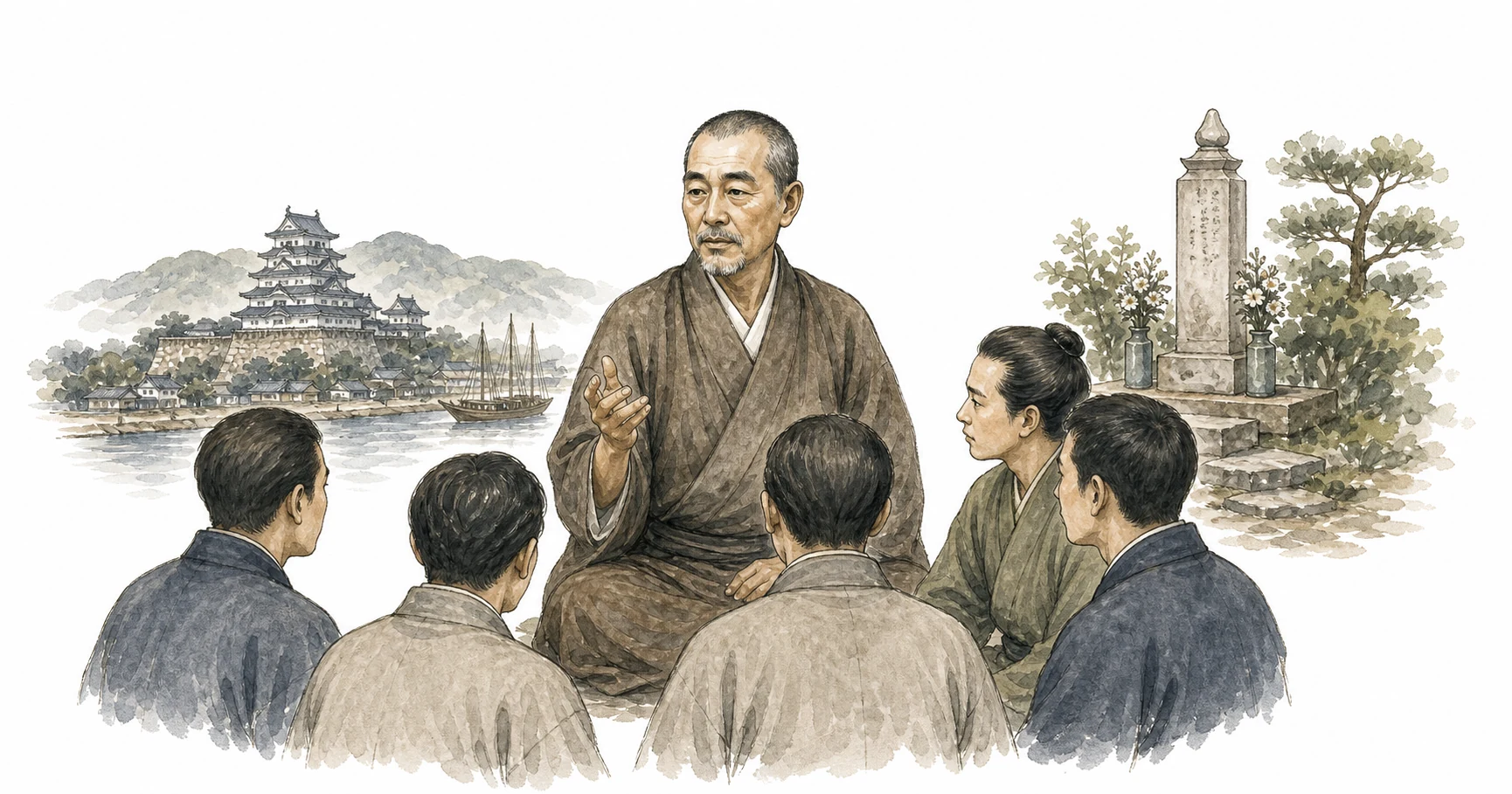
The memorial stone is our best source. It was erected by Usui's students at Saihoji Temple in Tokyo shortly after his death. The stone says that Usui 'became ill and passed away' in Fukuyama on 9 March 1926. It does not give a cause, but Japanese Reiki historians have confirmed from other records that he suffered a stroke.
He was sixty years old. In the Japan of 1926, that was a respectable lifespan, though not exceptionally long. The average life expectancy for Japanese men at the time was about 44 years, but that number was pulled down by high infant and child mortality. A man who survived childhood could expect to live into his sixties. Usui's age was unremarkable.
What is remarkable is how much he packed into those sixty years. He spent most of his life as a seeker, reading broadly, working ordinary jobs, practicing his spirituality quietly. Then in 1922, everything changed. He had his awakening. He founded his school. He treated thousands after the 1923 earthquake. He trained senior masters. And then, just four years later, he was gone.
Usui's Life Timeline
Key events from birth to death, showing the concentrated teaching period at the end.
1865-1921
56 years of seeking. Education, ordinary work, broad study across disciplines.
1922
Awakening on Mount Kurama. Founding of Usui Reiki Ryoho Gakkai.
1923
Great Kanto Earthquake. Usui treats thousands. Becomes widely known.
1924-1926
Teaching and training successors. Only four years of active public work.
9 March 1926
Death at age 60 in Fukuyama, Hiroshima.
The Final Days
- Usui travels to Fukuyama, Hiroshima prefecture, to teach.He was actively expanding his teaching beyond Tokyo when his health failed.
- Suffers a stroke and dies.His death was sudden. He had not named a formal successor, though senior students were trained.
- His students erect a memorial stone at Saihoji Temple in Tokyo.The stone provides the most reliable historical record of his life and death.
- His senior student Chujiro Hayashi continues teaching, eventually training Hawayo Takata.The lineage continued unbroken despite Usui's sudden death.
What Actually Happened
The Stroke That Ended a New Beginning
The memorial stone says only that Usui 'became ill and passed away.' This vagueness has led to speculation. Some Western sources have claimed he died of a broken heart or exhaustion from healing too many people. These are romantic additions, not historical facts.
Japanese researchers, including those who have accessed family records and medical documentation from the period, have confirmed the cause was a stroke. It was 1926. Stroke treatment was primitive. A stroke that would be survivable today was often fatal then.
The location is significant. Usui was in Fukuyama, Hiroshima, on a teaching trip. He was not at home in Tokyo. He was away from his family, working. This detail matters. Usui died as he lived: in the middle of his work, serving his students, spreading his system.
What He Left Behind
Four Years That Changed Healing
Think about what Usui accomplished in four years. In 1922, he was an unknown lay practitioner returning from a mountain retreat. By 1926, he had created a complete healing system, founded a school, trained senior masters, treated thousands of earthquake survivors, and seen his method begin to spread beyond Japan.
He did this while maintaining a household, raising children, and working as a healer for income. He was not supported by a wealthy patron or a religious institution. He built everything himself, with the help of his students.
If Usui had lived another twenty years, Reiki would be different. He might have written books. He might have systematized the teaching further. He might have taken Reiki to other countries himself. But he did not get those twenty years. He got four. And four was enough to change the world.
What the Legends Say About Usui's Death
Usui died young, in his forties or fifties.
He was 60, a normal lifespan for a Japanese man of his era who survived childhood.
He died of exhaustion from healing too many people.
Japanese records confirm a stroke. There is no evidence his healing work contributed to his death.
He died in Tokyo, near his school.
He died in Fukuyama, Hiroshima, on a teaching trip.
He knew he was dying and named a formal successor.
His death was sudden. Succession was handled by his senior students after his death.
In March of 1926, while staying in Fukuyama, he became ill and passed away. He was sixty years of age.
Key takeaways
The shortest useful version of this page.
Mikao Usui died on 9 March 1926 at the age of 60.
The cause of death was a stroke, though some sources describe it as a sudden illness.
He died in Fukuyama, Hiroshima, while on a teaching trip away from his family.
He had been teaching Reiki for only four years, from his awakening in 1922 to his death.
Despite the short teaching period, he trained successors who carried his system forward.
Frequently asked questions
Did Usui's death affect the spread of Reiki?
Yes and no. His sudden death meant he did not personally spread Reiki beyond Japan. But he trained senior students who did that work. The lineage continued unbroken.
Where is Usui buried?
His memorial stone is at Saihoji Temple in Suginami, Tokyo. His actual remains may be elsewhere; the stone is a memorial, not necessarily a grave.
Did Usui suffer before he died?
We do not know. The sources simply say he 'became ill and passed away.' There is no detailed description of his final days.
Was anyone with him when he died?
He was on a teaching trip, so students were likely present, possibly including his senior students. But we do not have a detailed account.
Sources
Sources are listed for transparency. A citation supports only the claim it directly addresses. Prefer primary research, systematic reviews, government health agencies and official institutional pages when evaluating health-related statements.
- Usui Memorial Stone, Saihoji Temple, Tokyo, translated by Hyakuten Inamoto
- Frank Arjava Petter, Reiki Fire, 1997
- Japanese historical research by Tetsuya Ishii and others
- Bronwen and Frans Stiene, The Reiki Sourcebook, 2003
Found a broken source or unsupported claim? Report a correction .