The Stone and the Temple
Where Reiki Practitioners Go to Remember
Saihoji Temple sits in a quiet residential neighborhood in Suginami, a western district of Tokyo. It is not a famous temple. Most Tokyo residents have never heard of it. It has no grand gates, no famous gardens, no tourist buses. It is a working Buddhist temple serving a local community.
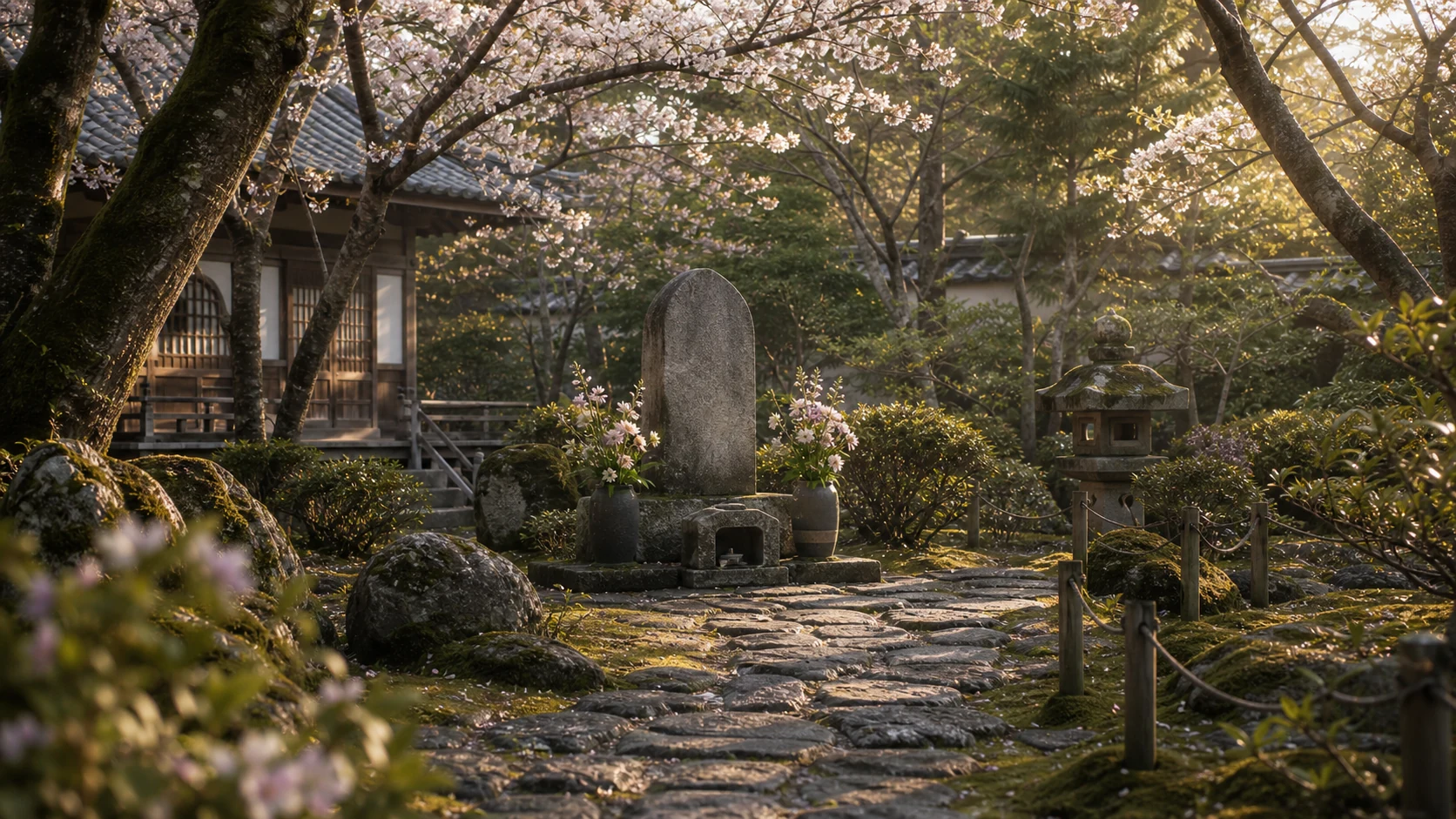
In the temple's garden, near the back, stands a stone monument about a meter and a half tall. On it, carved in Japanese characters, is the story of Mikao Usui. The stone was erected in 1927, one year after Usui's death, by his students. The lead student was Chujiro Hayashi, who would later train Hawayo Takata and bring Reiki to the West.
For Reiki practitioners, this stone is irreplaceable. It is the only contemporary monument to Usui from people who knew him. It is the closest thing Reiki has to scripture carved in stone. To stand before it is to stand in the presence of the tradition itself.
Saihoji Temple Grounds
A simple map of the temple layout showing the location of the Usui memorial stone.
Temple Entrance
From the street. Quiet residential neighborhood. No large signs.
Main Temple Building
Working Buddhist temple. Services held regularly. Not a museum.
Garden
Peaceful space. Trees, stones, traditional Japanese garden elements.
Usui Memorial Stone
Located near the back of the garden. About 1.5 meters tall. Carved inscription.
The Stone's History
- Mikao Usui dies in Fukuyama.His students begin planning how to honor him.
- Students erect memorial stone at Saihoji Temple.Creates a permanent monument to Usui and his teachings.
- The stone stands in quiet obscurity. Few Westerners know of it.Reiki spreads in the West without knowledge of this primary source.
- Japanese Reiki researchers rediscover the stone and translate its inscription.The Western Reiki community learns the truth about Usui's Buddhist background and lay status.
- Saihoji becomes an international pilgrimage site.Reiki practitioners from around the world travel to Tokyo to honor Usui at his memorial.
What the Stone Says
The Words Carved in Stone
The inscription on the Usui memorial stone is not long. It fills perhaps five hundred Japanese characters. But those five hundred characters are the most important written source we have about Reiki's founder.
It begins by describing Usui's character: 'His personality was gentle and humble. He never displayed arrogance. His physique was large and sturdy. He always wore a faint smile on his face.'
It describes his quest: 'He wanted to discover the method of healing people who were sick and suffering that the ancient masters had used. So he devoted himself to spiritual discipline.'
It describes the Mount Kurama retreat: 'He climbed Mount Kurama and fasted for twenty-one days. At dawn on the last day, he suddenly felt a great spiritual power and received the secret method of Reiki Ryoho.'
It describes his teaching and his death: 'He taught many people. In March of 1926, while staying in Fukuyama, he became ill and passed away. He was sixty years of age.'
The Journey to Saihoji
Why Reiki Practitioners Travel to Tokyo
There is no requirement in Reiki to visit Saihoji. No teacher will tell you that your attunement is incomplete if you have not stood before the stone. And yet, Reiki practitioners go. They go from Brazil and Germany and Australia and the United States. They go from places Usui never heard of, speaking languages he never spoke.
Why do they go? Because something happens there. Practitioners report a sense of presence, of connection, of being held by something larger than themselves. They report crying without knowing why. They report feeling the lineage like electricity through their bodies.
The stone does not perform miracles. It does not heal. It is a rock with writing on it. But it is a rock that was placed there by people who loved Usui, who learned from him, who wanted the world to remember him. When you stand before it, you stand in the stream of that love. That is enough.
What the Temple Is and Is Not
Usui built Saihoji Temple.
Saihoji existed for centuries before Usui. He had no connection to its founding.
Usui is buried at Saihoji.
The stone is a memorial. His actual remains may be elsewhere.
Saihoji is a Reiki temple.
It is a Buddhist temple. It has no official Reiki affiliation. The stone is on its grounds.
You need special permission to visit.
The temple is open to the public. Visitors are welcome to see the stone during regular hours.
Just as the cherry blossoms bloom again each spring, may the teachings of Reiki Ryoho spread throughout the world forever.
Key takeaways
The shortest useful version of this page.
The Mikao Usui temple is Saihoji Temple in Suginami, Tokyo, where his memorial stone is located.
The stone was erected by Usui's students in 1927, one year after his death.
The inscription on the stone is the most reliable contemporary source on Usui's life and character.
Saihoji has become an informal pilgrimage site for Reiki practitioners worldwide.
The stone is a memorial, not Usui's grave. His actual remains may be elsewhere.
Frequently asked questions
Can anyone visit the Usui memorial stone?
Yes. Saihoji Temple is open to the public. Visitors are welcome to see the stone during regular temple hours.
Is there a fee to visit?
No. The temple does not charge for visitors. Donations are welcome.
Is Usui buried at Saihoji?
The stone is a memorial. His actual burial location is not definitively known, though some believe his remains are in Fukuyama, where he died.
Do I need to be Reiki attuned to visit?
Not at all. The stone is historically significant regardless of your personal practice. Many visitors are not Reiki practitioners.
What should I do when I visit?
There is no required protocol. Most practitioners bow, meditate briefly, or simply stand quietly. Respectful behavior is appropriate.
Sources
Sources are listed for transparency. A citation supports only the claim it directly addresses. Prefer primary research, systematic reviews, government health agencies and official institutional pages when evaluating health-related statements.
- Usui Memorial Stone inscription, Saihoji Temple, Tokyo, translated by Hyakuten Inamoto
- Frank Arjava Petter, Reiki Fire, 1997
- Bronwen and Frans Stiene, The Reiki Sourcebook, 2003
- Visitor accounts and pilgrimage reports from Reiki practitioners
Found a broken source or unsupported claim? Report a correction .