A Religion-by-Religion Guide
How Different Faith Traditions View Reiki
Reiki is not a religion. It is a practice. But it emerged from Buddhist contexts and uses concepts (ki, chakras, symbols) that have religious or spiritual associations.
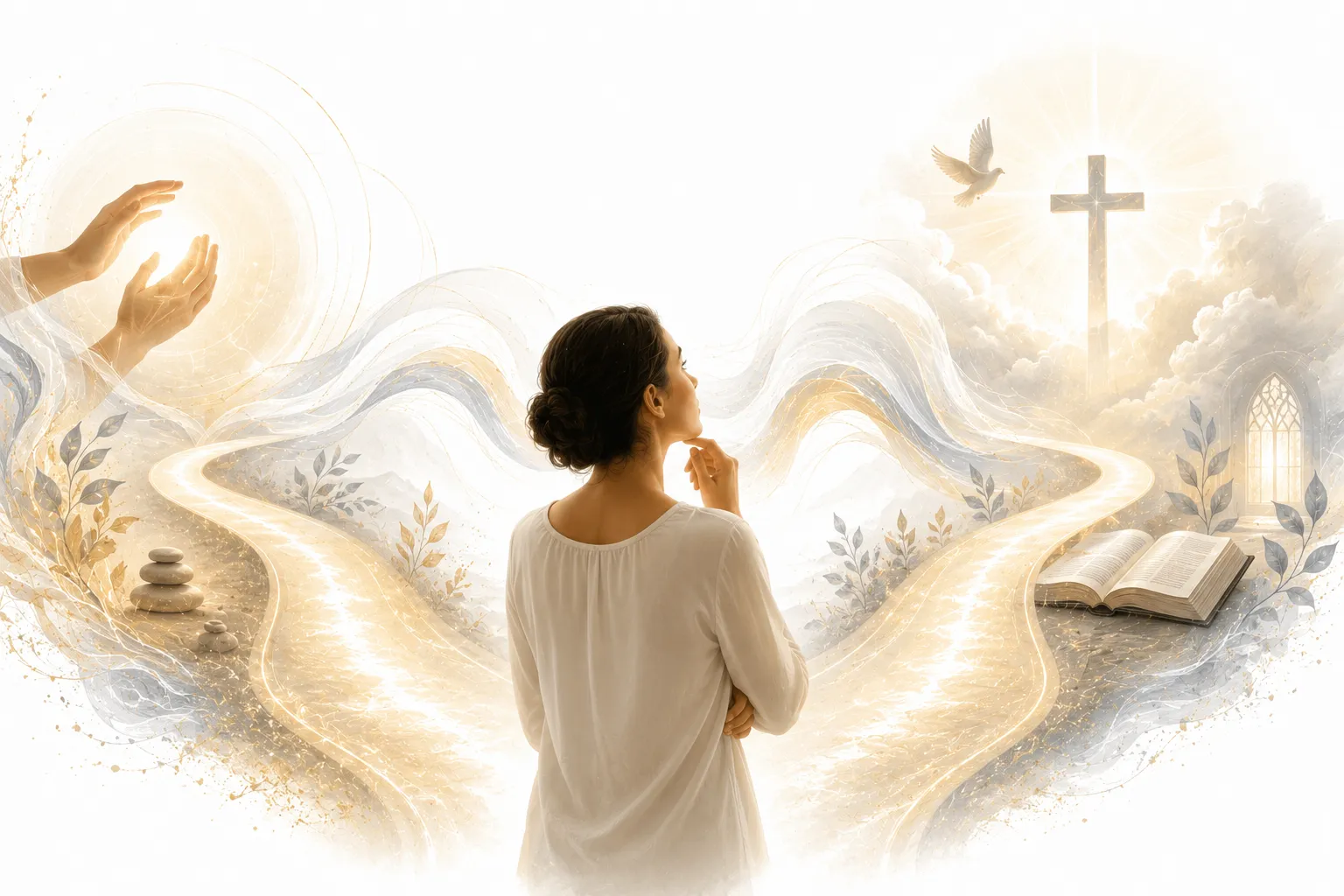
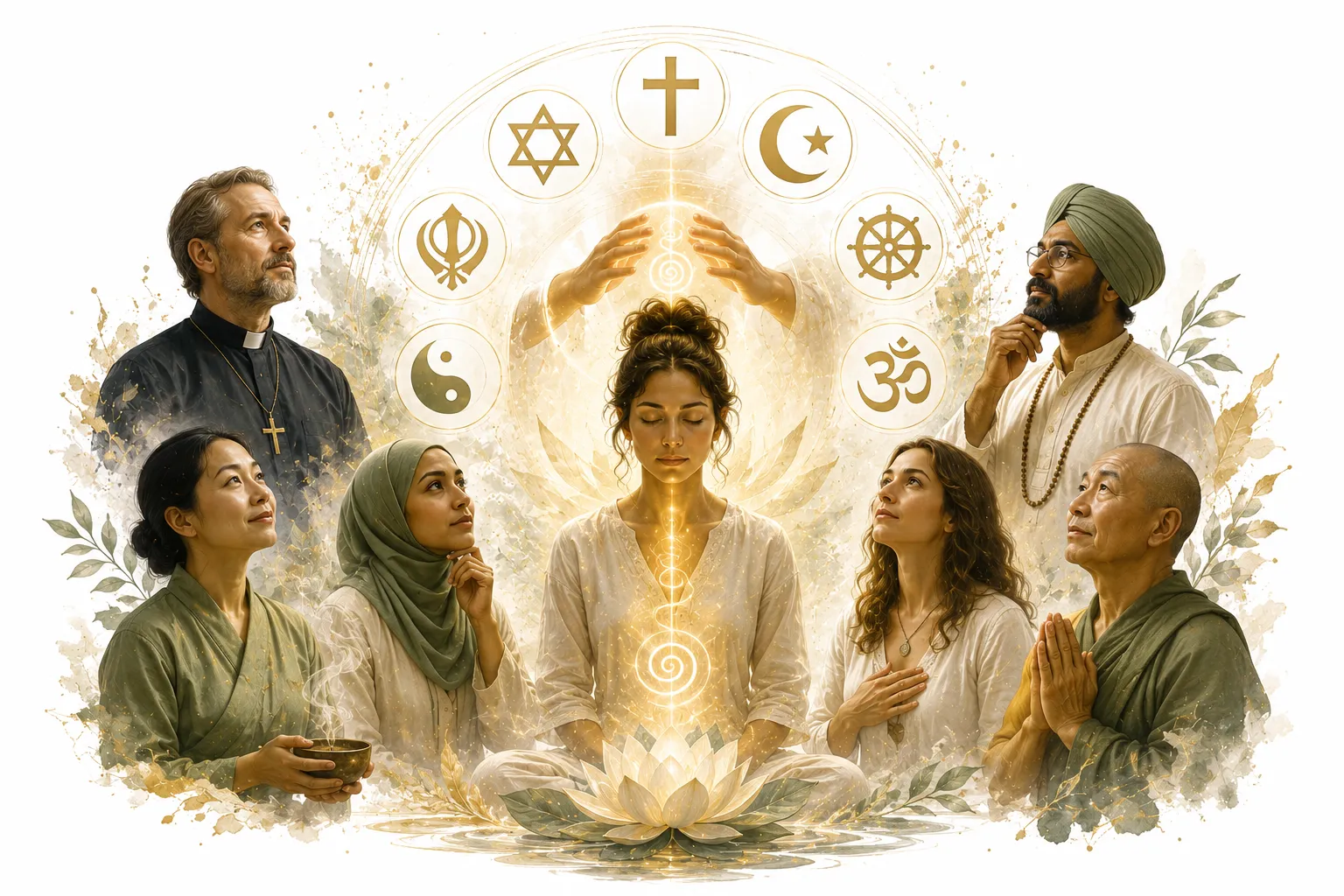
Different religious traditions evaluate Reiki differently. Some see it as compatible energy healing. Others see conflicts with core teachings.
This guide provides an overview. It is not a substitute for consulting your own religious leaders. Individual decisions require individual guidance.
Religious Views on Reiki
A spectrum from most to least compatible.
Most Compatible
Buddhism, Hinduism. Similar energy concepts. Reiki emerged from Buddhist contexts.
Mixed
Judaism, some Protestant Christianity. No consensus. Individual variation.
Least Compatible
Catholic Christianity (Vatican), some Islamic scholars. Concerns about source of healing, non-religious symbols.
Christian Perspectives
Does Reiki Conflict with Christianity?
The most authoritative Christian statement on Reiki came from the Vatican in 2009. The Congregation for the Doctrine of the Faith stated that Reiki is not compatible with Catholic teaching. The main reason: Reiki's concept of ki as an impersonal energy does not align with Christian understanding of healing as coming from a personal God through prayer and sacrament.
However, many individual Christians and even some clergy disagree. They argue that ki is simply a name for God's life-giving energy. They see Reiki as a practical method for accessing the healing that God intends.
Protestant denominations have no official position. Views range from acceptance to rejection. Many individual Protestants practice Reiki without conflict.
Islamic Perspectives
Does Reiki Conflict with Islam?
Islamic scholars have differing views on Reiki. The central concern is shirk: associating partners with Allah. If Reiki involves calling on non-Islamic spiritual forces, or if it treats 'ki' as a power separate from Allah, that could be problematic.
Some scholars argue Reiki is permissible (halal) as a form of energy healing, as long as it does not involve shirk. They view 'ki' as energy created by Allah. Others argue Reiki is impermissible (haram) because its concepts conflict with tawhid.
Many Muslims practice Reiki by reframing it within Islamic terms: seeing the energy as from Allah, using Quranic recitation instead of symbols, and treating it as ruqyah (spiritual healing).
Jewish Perspectives
Does Reiki Conflict with Judaism?
Jewish perspectives on Reiki are mixed. The main concern is avodah zarah (foreign worship). If Reiki involves practices or concepts from other religions, it could be problematic.
Some rabbis permit Reiki as a form of energy healing, arguing that it is a technique, not a religion. Others are more cautious, concerned about the Buddhist origins of some Reiki concepts.
Many Jewish Reiki practitioners integrate Reiki with Jewish prayer and concepts, seeing healing as coming from God and Reiki as a tool.
Buddhist Perspectives
Does Reiki Conflict with Buddhism?
Reiki is generally compatible with Buddhism. Mikao Usui, the founder of Reiki, was a Tendai Buddhist lay practitioner. The Reiki principles (not anger, not worry, gratitude, honest work, kindness) are consistent with Buddhist ethics.
Some Buddhist practitioners use Reiki as a form of meditation or compassion practice. The focus on energy and healing fits within Buddhist frameworks.
However, some Buddhist teachers note that Reiki is not inherently Buddhist. It is a practice that emerged from a Buddhist context but can be practiced by people of any or no religion.
Key takeaways
The shortest useful version of this page.
Whether Reiki goes against religion depends on the specific religious tradition.
Buddhism and Hinduism are generally compatible with Reiki.
Christianity, Islam, and Judaism have mixed views. No consensus.
The Vatican (2009) stated Reiki is not compatible with Catholic teaching.
Many religious individuals practice Reiki by reframing it within their faith.
Consult your religious leaders and follow your conscience.
Frequently asked questions
Is Reiki a religion?
No. Reiki is a practice, not a religion. It has no required beliefs, no deity, no scripture. It can be practiced by people of any or no religion.
Can I practice Reiki and still be a good Christian/Muslim/Jew?
That depends on your tradition and interpretation. Many religious people practice Reiki without conflict. Others believe it is not compatible. Consult your religious leaders.
Does the Vatican allow Reiki?
No. A 2009 Vatican document stated that Reiki is not compatible with Catholic teaching. Some Catholics disagree and practice Reiki anyway.
Is there a way to practice Reiki that is more compatible with my religion?
Yes. Many people adapt Reiki by reframing its concepts within their faith. For example, seeing ki as energy from God, replacing symbols with prayer, and emphasizing intention.
Should I stop practicing Reiki if my religion says it is not allowed?
That is a personal decision between you and your religious community. Seek guidance from knowledgeable religious leaders. Follow your conscience.
Sources
Sources are listed for transparency. A citation supports only the claim it directly addresses. Prefer primary research, systematic reviews, government health agencies and official institutional pages when evaluating health-related statements.
- Congregation for the Doctrine of the Faith, Jesus Christ, the Bearer of the Water of Life, 2009.
- Islamic scholarly opinions on Reiki.
- Jewish responsa on energy healing.
- Buddhist teachings on Reiki and energy practice.
- Bronwen and Frans Stiene, The Reiki Sourcebook, 2003.
Found a broken source or unsupported claim? Report a correction .