A Complex Relationship
Where Christianity and Reiki Meet and Diverge
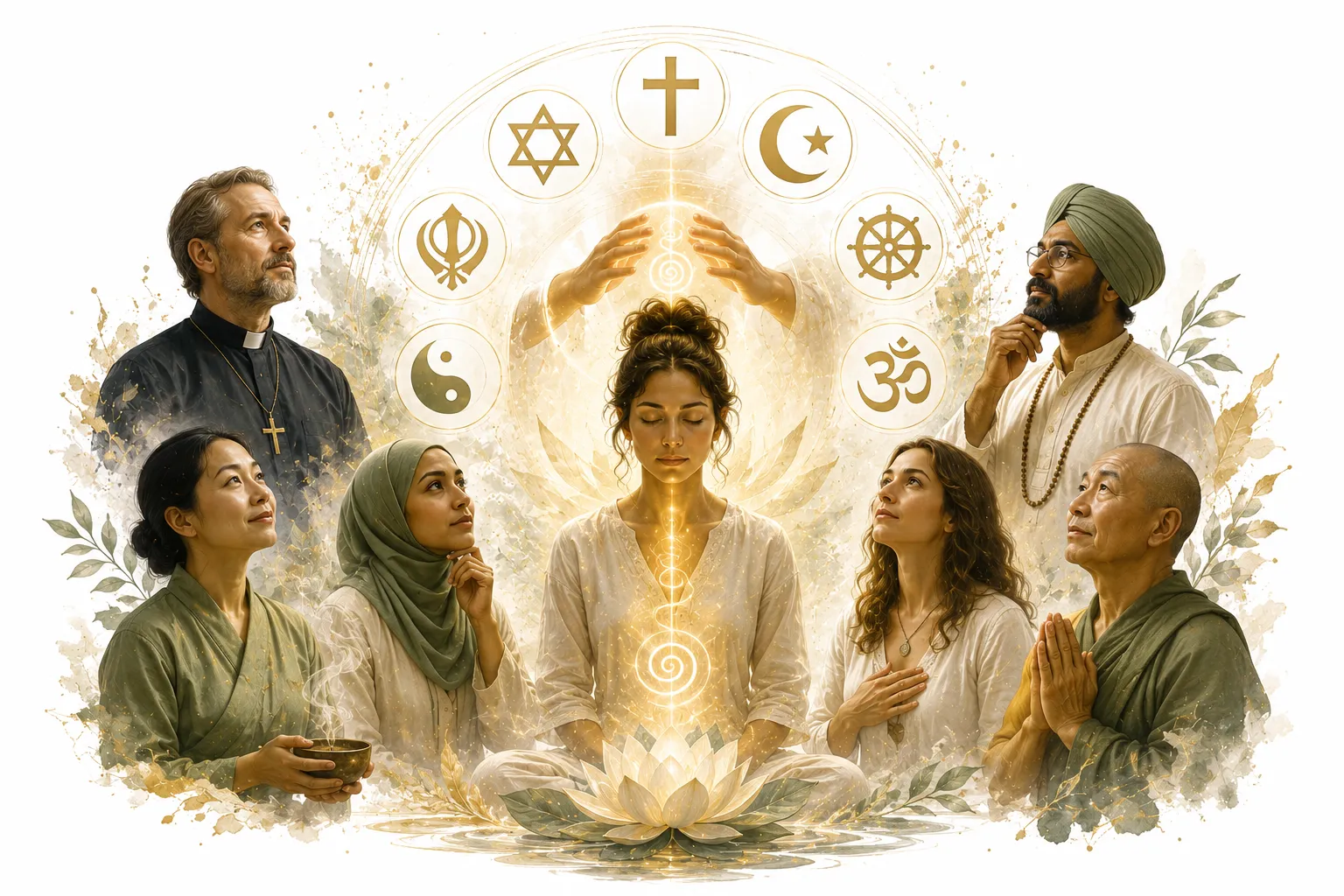
The relationship between Christianity and Reiki is complicated because both are diverse. Christianity has thousands of denominations with different theologies. Reiki has multiple lineages and interpretations. Asking if Reiki goes against Christianity is like asking if a key fits a lock. It depends on the key and the lock.
The most authoritative Christian statement against Reiki came from the Vatican in 2009. The Congregation for the Doctrine of the Faith issued a document stating that Reiki is not compatible with Catholic teaching. The main reason: Reiki's concept of ki as an impersonal energy does not align with the Christian understanding of healing as coming from a personal God through prayer and sacrament.
However, many individual Christians and even some clergy disagree with this conclusion. They argue that ki is simply a name for God's life-giving energy, mentioned in scripture as the breath of God, the ruach. They see Reiki as a practical method for accessing the healing that God intends for all people.
Christian Perspectives on Reiki
A spectrum of Christian views from full acceptance to full rejection.
Full Acceptance
Reiki is God's healing energy. No conflict. Practiced as prayer.
Conditional Acceptance
Accept if Reiki is practiced as Christian prayer and symbols are understood as focus tools, not spiritual powers.
Concerned but Accepting
Has concerns about source and method but believes God can work through any sincere practice.
Rejection with Respect
Sees Reiki as incompatible but respects practitioners' intentions.
Full Rejection
Sees Reiki as spiritually dangerous or incompatible with Christian faith.
The Christian-Reiki Conversation
- Reiki spreads in the West, including among Christians.Christians begin practicing Reiki without major controversy at first.
- Christian Reiki books appear, attempting to integrate Reiki with Christian faith.Creates a visible movement of Christians who practice Reiki.
- Vatican issues document stating Reiki is not compatible with Catholic teaching.Becomes the most authoritative Christian statement against Reiki.
- Debate continues. Some Christians leave Reiki. Others continue. New integrations emerge.No consensus reached. Individual Christians make personal decisions.
Official Catholic Teaching
What the Vatican Said About Reiki in 2009
In 2009, the Vatican's Congregation for the Doctrine of the Faith issued a document titled 'Jesus Christ, the Bearer of the Water of Life.' The document was about New Age practices. It addressed Reiki specifically.
The document stated that Reiki is not compatible with Catholic teaching. The main reasons: Reiki's concept of ki is an impersonal energy, while Catholic teaching holds that healing comes from a personal God through Christ. Reiki does not require faith in Christ. And Reiki practice involves techniques that are not sacramental.
The document's authority is significant. It was approved by Pope Benedict XVI. Catholic faithful are expected to give religious submission of intellect and will to such teachings. However, the document is not infallible. Some Catholics continue to practice Reiki while understanding it differently from the Vatican's description.
A Different Interpretation
How Some Christians Integrate Reiki With Faith
Christian Reiki practitioners argue that the Vatican's document misunderstands both Reiki and the possibility of integration. They point out that ki appears in the Bible as ruach, the breath of God. 'The Spirit of God moved upon the face of the waters,' Genesis says. That moving Spirit is ki.
They argue that Reiki does not require belief in any non-Christian deity. The Usui principles are compatible with Christian ethics: do not worry, do not anger, be grateful, work honestly, be kind. Jesus taught similar things.
For Christian Reiki practitioners, Reiki is a method, not a religion. It is a way of praying with hands. The healing comes from God. The practitioner is simply a channel. They see no conflict because the source is the same: the God who heals.
Christianity and Reiki: A Side-by-Side Look
How core concepts compare between traditional Christianity and traditional Reiki.
Source of healing
Personal God (Father, Son, Holy Spirit)
Impersonal universal life energy (ki)
Access to healing
Prayer, sacrament, faith in Christ
Attunement, intention, hand placement
Role of practitioner
Pray-er, intercessor, minister
Channel, conduit, facilitator
Scripture or text
The Bible
Usui's principles, oral tradition
Necessary belief
Faith in Christ
No particular belief required
What People Get Wrong About Reiki and Christianity
The Vatican banned Reiki for all Christians.
The Vatican stated Reiki is not compatible with Catholic teaching. This applies to Catholics. Other Christians are not bound by Vatican statements.
Reiki requires belief in Buddha or other non-Christian deities.
Reiki does not require any belief. It is a practice, not a religion. Many Reiki practitioners are atheists or agnostics.
All Christians reject Reiki.
Many Christians practice Reiki and find it compatible with their faith. Christian Reiki is a growing movement.
Reiki is a form of witchcraft or divination.
Reiki does not involve spirits, divination, or attempts to predict the future. It is hands-on energy work.
Key takeaways
The shortest useful version of this page.
There is no single Christian answer. Views range from full acceptance to full rejection.
The Vatican (2009) stated Reiki is not compatible with Catholic teaching.
Many individual Christians practice Reiki without faith conflict.
The main theological concern is the source of healing: God or impersonal ki.
Christian Reiki practitioners see ki as God's energy, not a separate power.
This is a personal decision. Prayerful reflection and pastoral guidance are recommended.
Frequently asked questions
Can a Catholic receive Reiki?
The Vatican says Reiki is not compatible with Catholic teaching. However, some Catholics receive Reiki and see no conflict. This is a personal decision with pastoral implications.
Does the Bible mention energy healing like Reiki?
The Bible describes Jesus and the apostles healing through touch and prayer. It does not mention ki or a universal life energy. Some Christians see the laying on of hands as biblical precedent for Reiki.
Is there a Christian version of Reiki?
Some Christian Reiki practitioners have developed explicitly Christian Reiki systems that use Christian symbols and language. These are not traditional Reiki but adaptations.
What should a Christian do if they are curious about Reiki?
Pray about it. Study both Reiki and your Christian tradition's teachings. Talk to your pastor or spiritual director. Make an informed, prayerful decision.
Does Reiki replace prayer?
Most Reiki practitioners, including Christian ones, see Reiki as complementary to prayer, not a replacement. Many pray before, during, or after Reiki sessions.
Sources
Sources are listed for transparency. A citation supports only the claim it directly addresses. Prefer primary research, systematic reviews, government health agencies and official institutional pages when evaluating health-related statements.
- Congregation for the Doctrine of the Faith, Jesus Christ, the Bearer of the Water of Life, 2009
- Christian Reiki practitioners' personal accounts and writings
- Bronwen and Frans Stiene, The Reiki Sourcebook, 2003
- Various Protestant and Catholic theological commentaries on energy healing
Found a broken source or unsupported claim? Report a correction .