Ancient Ingredients, Modern Recipe
What Existed Before Usui and What He Created
The specific practice called Reiki began with Mikao Usui in 1922. There is no record of anyone using the term 'Reiki' for this specific system before him.
However, the concepts that make up Reiki are ancient. The idea of a universal life energy (ki) appears in many cultures. The practice of laying on of hands for healing appears in the Bible, in Buddhist traditions, and in indigenous healing practices worldwide.
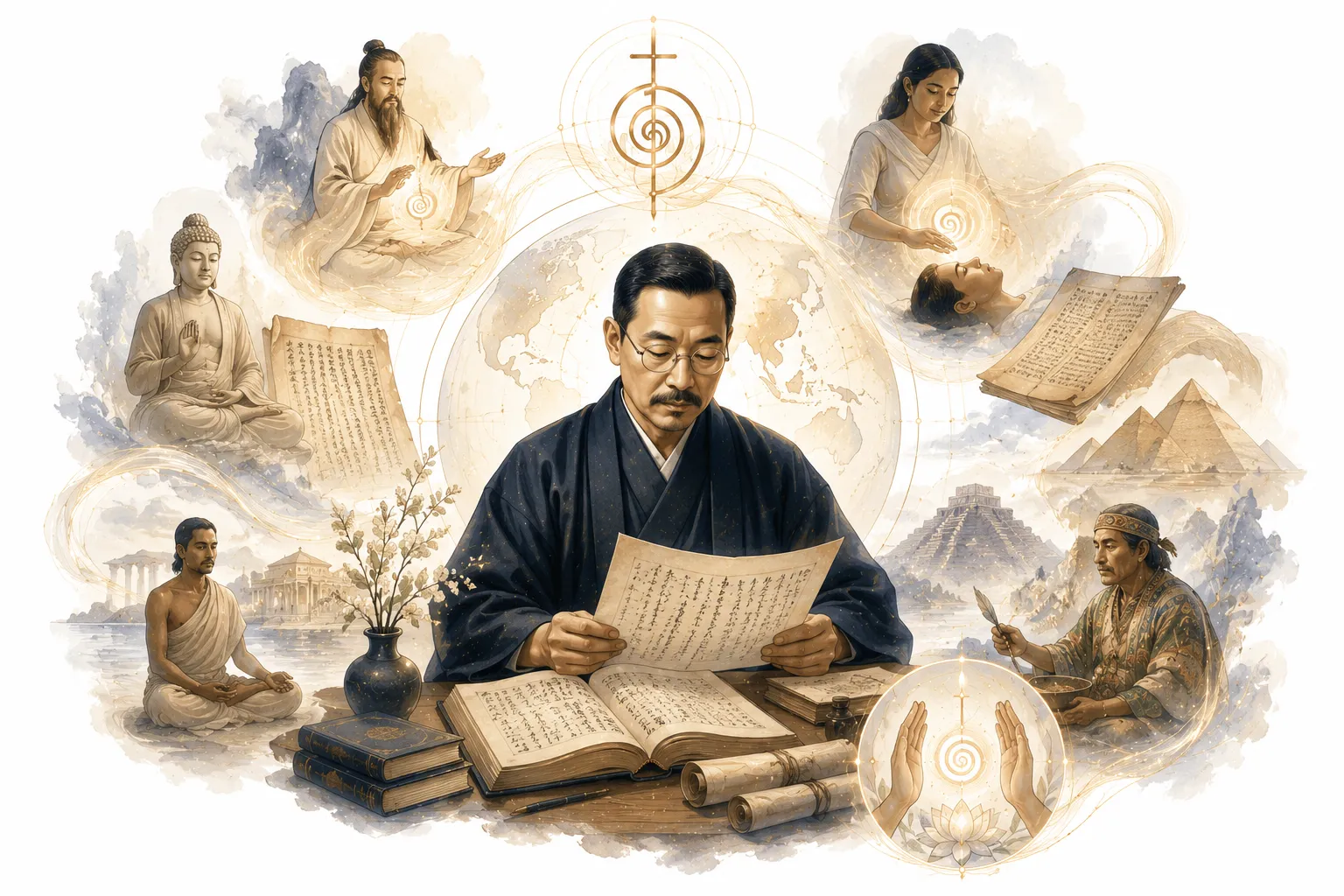
Usui's genius was synthesis. He took these ancient concepts and created a specific system. He added attunements, standard hand positions, symbols, and the five principles. He made something new from something old.
Ancient Influences on Reiki
The ancient traditions that contributed to Usui's system.
Chinese Qi
Life energy in Chinese medicine. Acupuncture, tai chi, qigong.
Indian Prana
Life energy in Indian yoga and Ayurveda. Chakras, nadis.
Buddhist Practice
Meditation, compassion, laying on of hands. Tendai tradition.
Christian Healing
Laying on of hands, prayer. Biblical references.
Shinto
Japanese indigenous spirituality. Purification, energy concepts.
Usui's Reiki
Synthesis of ancient concepts into a specific system with attunements, hand positions, symbols, principles.
The Timeline of Energy Healing
- Laying on of hands appears in many cultures. The Bible describes Jesus healing by touch.Hands-on healing is a universal human practice.
- Chakras and prana concepts develop in yoga and Ayurveda.Provides the energy anatomy that Reiki uses.
- Qi concept develops in Chinese medicine. Acupuncture and qigong emerge.Provides the life energy concept that Reiki uses.
- Buddhism reaches Japan. Esoteric practices develop.Creates the spiritual context for Usui.
- Usui develops Reiki on Mount Kurama.The specific system called Reiki is born.
The Universal Ingredient
The Ancient Idea of Life Energy
Almost every ancient culture has a concept of life energy. In China, it is qi. In India, it is prana. In Japan, it is ki. In Hebrew tradition, it is ruach (breath of God). In Greek philosophy, it is pneuma.
These concepts are not identical, but they are similar. They all describe an invisible energy that animates living things. They all describe ways to work with this energy for healing.
Usui did not invent the concept of ki. He inherited it. He was a Japanese man living in Japan. Ki was part of his culture. He used it as the foundation of Reiki.
The New Recipe
What Usui Added That Was New
Usui's innovation was not the concept of ki. It was the system. He created a specific practice that included: attunements (reiju) to open energy channels, standard hand positions for self-treatment and treating others, symbols to focus intention, the five principles for daily living, and a three-level structure for teaching.
No one had combined these elements into a single system before. Usui was the first. That is why he is the founder.
There were other energy healing practices before Usui. There were other hands-on healing traditions. But there was no Reiki. Reiki is Usui's invention.
Reiki vs Other Energy Healing Practices
How Reiki compares to similar practices that existed before Usui.
Origin
Japan, 1922
Ancient China
1990s, India
1970s, US
Ancient Israel
Key concept
Ki (life energy)
Qi (life energy)
Prana (life energy)
Human energy field
Divine power
Attunements
Yes
No
No
No
No
Symbols
Yes
No
No
No
No
Principles
Five principles
Various
Various
Various
Biblical ethics
Key takeaways
The shortest useful version of this page.
The specific system called Reiki did not exist before Mikao Usui. He developed it in 1922.
The concepts behind Reiki are ancient: ki, chakras, laying on of hands, energy healing.
Many cultures have their own energy healing traditions. They are not Reiki.
Usui's innovation was synthesizing ancient concepts into a specific system with attunements, hand positions, symbols, and principles.
Reiki is both ancient and modern. The ingredients are old. The recipe is new.
Frequently asked questions
Was there energy healing before Reiki?
Yes. Many cultures have energy healing traditions: Chinese qigong, Indian pranic healing, Christian laying on of hands, and others.
Is Reiki just a copy of older practices?
No. Reiki is a specific system that synthesizes ancient concepts in a unique way. The attunements, hand positions, symbols, and principles are Usui's innovations.
Did Usui invent ki?
No. Ki is a Japanese concept that existed long before Usui. He used it as the foundation of Reiki.
Are there older practices that look like Reiki?
Yes. Many hands-on healing practices resemble Reiki. But they are not Reiki. Reiki is a specific system.
Does it matter if Reiki existed before Usui?
Not really. What matters is whether Reiki helps you. The origins are interesting. The practice is what heals.
Sources
Sources are listed for transparency. A citation supports only the claim it directly addresses. Prefer primary research, systematic reviews, government health agencies and official institutional pages when evaluating health-related statements.
- Frank Arjava Petter, Reiki Fire, 1997.
- Bronwen and Frans Stiene, The Reiki Sourcebook, 2003.
- Chinese medicine and qigong literature.
- Indian yoga and pranic healing literature.
- Biblical references to laying on of hands.
Found a broken source or unsupported claim? Report a correction .