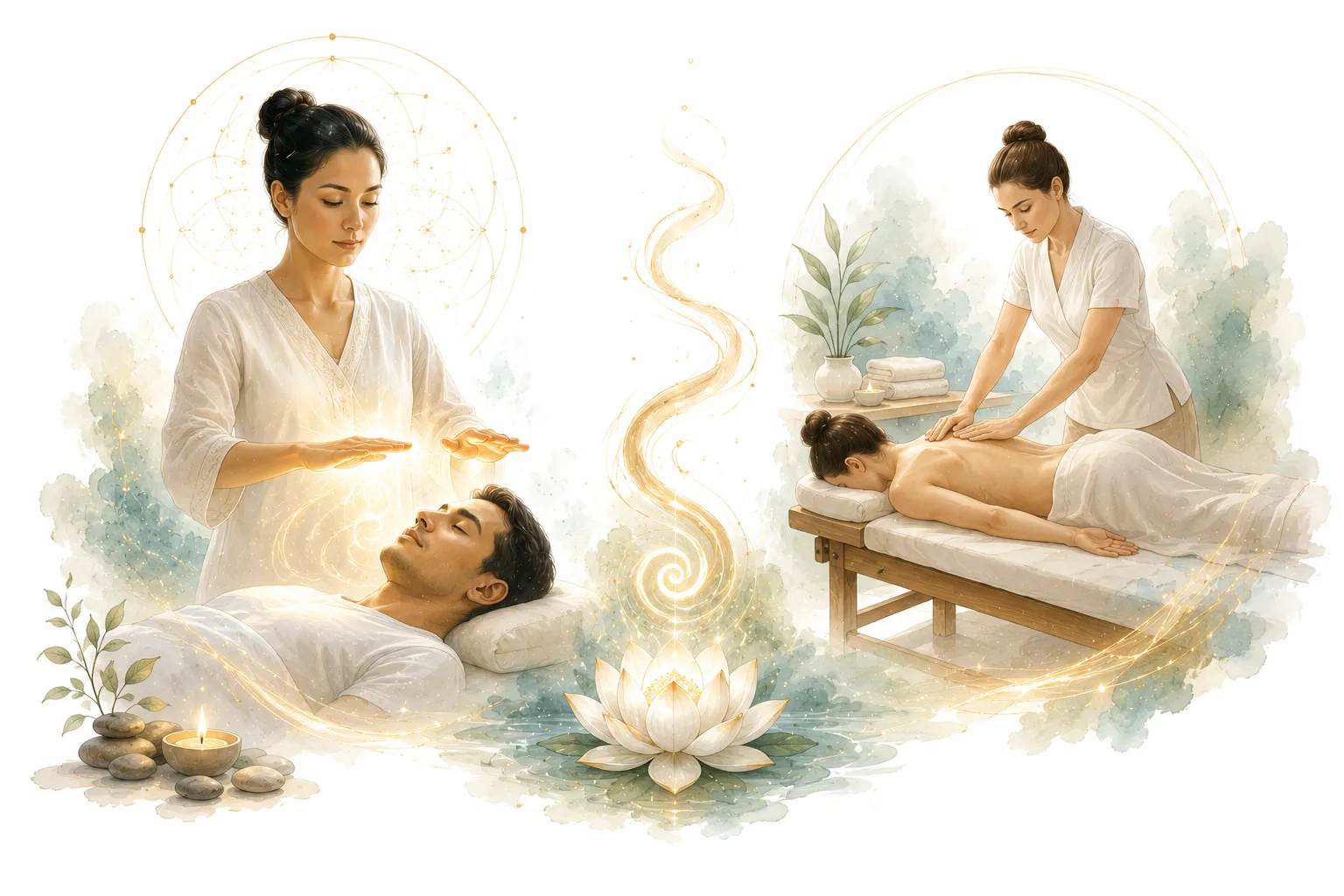
Different Modalities, Different Goals
Key Differences Between Reiki and Massage
Reiki and massage are often confused because both involve touch and both are offered in wellness settings. But they are fundamentally different.
Massage is bodywork. It manipulates muscles, tendons, and soft tissue. The goal is to release physical tension, improve circulation, and relieve pain. Massage uses pressure, kneading, rubbing, and stretching.
Reiki is energy work. The practitioner places hands gently on or near the body and holds them still. There is no manipulation. The goal is to balance energy flow and activate the relaxation response. Reiki uses intention, not pressure.
Reiki vs Massage
A side-by-side comparison of key features.
Reiki
Gentle, still touch or hovering. Fully clothed. No pressure. Goal: energy flow and relaxation.
Massage
Kneading, rubbing, pressure. Often undressed (with draping). Goal: muscle tension, circulation, physical pain.
Combined
Some practitioners offer both. Massage then Reiki, or Reiki integrated into massage.
Still Hands
What Reiki Touch Feels Like
Reiki touch is gentle. The practitioner places their hands on or near your body. The hands are still. They do not move. They do not knead or rub.
You might feel warmth. You might feel tingling. You might feel nothing at all. But you will not feel pressure or manipulation.
Some Reiki practitioners use hovering hands. They never touch the body. Others use light touch. Both are Reiki. Neither is massage.
Working the Muscles
What Massage Touch Feels Like
Massage involves manipulation. The therapist kneads, rubs, presses, and stretches your muscles. You feel pressure. Sometimes light. Sometimes deep.
Massage targets specific muscle groups. The therapist works on knots, tension, and tightness. You may feel some discomfort during deep work, followed by relief.
You typically undress for a massage, though you are draped with a sheet. The therapist uses oil or lotion to reduce friction on the skin.
Detailed Comparison: Reiki vs Massage
A side-by-side look at every aspect.
Type of touch
Gentle, still, hovering
Kneading, rubbing, pressure, stretching
Clothing
Fully clothed
Often undressed (draped with sheet)
Oil or lotion
No
Yes, typically
Pressure
None
Light to deep
Goal
Energy flow, relaxation, stress reduction
Muscle tension, circulation, pain relief
Training
Attunements, energy theory
Anatomy, physiology, technique
Regulation
Generally not regulated
Licensed in most jurisdictions
Can it hurt?
No
Can be uncomfortable during deep work
Key takeaways
The shortest useful version of this page.
Reiki does not include massage. They are different modalities.
Reiki uses gentle, still touch or hovering hands. No manipulation.
Massage uses kneading, rubbing, pressure, and stretching on muscles.
You remain fully clothed for Reiki. You may undress for massage.
Some practitioners offer both. They are separate services.
Neither is better. They are different tools for different needs.
Frequently asked questions
Can I get Reiki and massage in the same session?
Yes, some practitioners offer both. They may do massage first to release physical tension, then Reiki to balance energy. Clarify what you are booking.
Which is better for stress, Reiki or massage?
Both help with stress. Some researchers have explored whether Reiki sessions are associated with relaxation-related physiological changes, but current evidence does not establish a Reiki-specific mechanism. Massage reduces muscle tension. Try both and see which you prefer.
Do I need to undress for Reiki?
No. You remain fully clothed for Reiki. Wear comfortable, loose-fitting clothing.
Does Reiki use oil or lotion?
No. Reiki does not use oil or lotion. Hands are placed on or near clothing or directly on skin without lubricant.
Can a massage therapist also do Reiki?
Yes, if they have received Reiki attunement. Many massage therapists offer Reiki as an add-on service.
Sources
Sources are listed for transparency. A citation supports only the claim it directly addresses. Prefer primary research, systematic reviews, government health agencies and official institutional pages when evaluating health-related statements.
- Bronwen and Frans Stiene, The Reiki Sourcebook, 2003.
- Massage therapy training standards.
- Practitioner experience and comparison.
Found a broken source or unsupported claim? Report a correction .