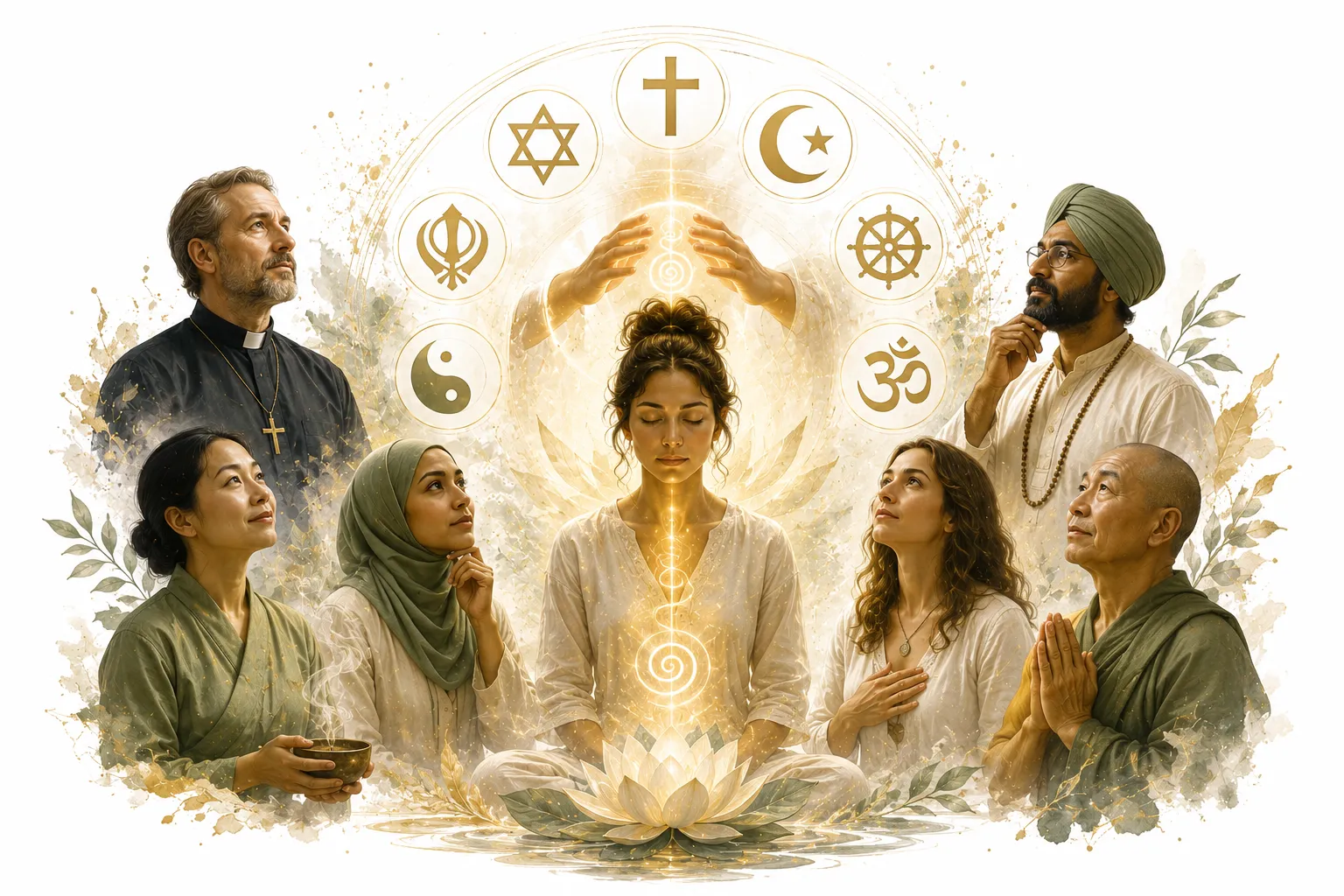
Practice, Not Doctrine
What Reiki Is and Is Not
Reiki is a practice, not a religion. It has no deity. It has no scripture. It has no required beliefs. It has no religious hierarchy.
Reiki emerged from Japanese Buddhist contexts. But it is not tied to Buddhism. It can be practiced by anyone, regardless of their religious background.
Many people integrate Reiki with their existing faith. Christians see it as God's energy. Muslims see it as Allah's creation. Buddhists see it as natural energy. Atheists see it as a relaxation technique.
Reiki vs Religion
A comparison of key features.
Religion
Deity, scripture, required beliefs, worship, hierarchy, salvation.
Reiki
No deity, no scripture, no required beliefs, practice, no hierarchy, healing.
Can Combine
Many people practice Reiki within their religious framework. Reiki is compatible with many religions.
Reiki's Relationship with Religion
- Usui develops Reiki in Japan. He is a Buddhist lay practitioner.Reiki emerges from a Buddhist context.
- Takata brings Reiki to the West. She presents it as non-religious.Reiki becomes accessible to people of all faiths.
- Reiki is practiced by people of many religions and none.Reiki is truly inclusive.
A Practice, Not a Faith
Why Reiki Is Not a Religion
Reiki is not a religion because it has no deity. It does not ask you to believe in anything. It does not have a sacred text. It does not require worship.
Reiki is a practice. It is something you do. You place your hands. You intend healing. You receive energy. That is all.
You can practice Reiki and remain a Christian, Muslim, Jew, Buddhist, Hindu, or atheist. Reiki does not conflict with any religion. It adapts to the practitioner.
Reiki and Religion
How Reiki Is Compatible with Religion
Many people practice Reiki within their religious framework. Christians see the energy as God's healing. Muslims see it as energy from Allah. Jews see it as part of God's creation.
The key is intention. If you pray before Reiki, you are practicing Reiki within your faith. If you see Reiki as a relaxation technique, you are practicing it secularly.
Reiki does not require you to abandon your religion. It does not require you to adopt any new beliefs. It is a tool. It serves the user.
What People Get Wrong About Reiki and Religion
Reiki is a religion.
Reiki is a practice, not a religion. It has no deity, no scripture, no required beliefs.
You cannot practice Reiki if you are religious.
People of many religions practice Reiki without conflict.
Reiki requires belief in something.
Reiki does not require any particular belief. It works whether you believe in it or not.
Reiki conflicts with Christianity.
Some Christians practice Reiki without conflict. Others see conflicts. It depends on interpretation.
Key takeaways
The shortest useful version of this page.
Reiki is not a religion. It is a spiritual healing practice.
It has no deity, no scripture, no required beliefs, and no hierarchy.
Reiki can be practiced by people of any faith or none.
Reiki is compatible with many religions. It adapts to the practitioner.
Reiki does not require you to abandon your religion or adopt new beliefs.
Reiki is a tool. It serves the user.
Frequently asked questions
Is Reiki a religion or a spiritual practice?
Reiki is a spiritual practice, not a religion. It has no deity, no scripture, and no required beliefs.
Can I practice Reiki if I am Christian?
Yes. Many Christians practice Reiki. They see the energy as God's healing.
Can I practice Reiki if I am Muslim?
Yes. Some Muslims practice Reiki. They see the energy as from Allah. Consult a knowledgeable scholar.
Does Reiki require belief in anything?
No. Reiki does not require any particular belief. It works whether you believe in it or not.
Can I practice Reiki if I am atheist?
Yes. Many atheists practice Reiki as a relaxation technique. They do not need to believe in anything.
Sources
Sources are listed for transparency. A citation supports only the claim it directly addresses. Prefer primary research, systematic reviews, government health agencies and official institutional pages when evaluating health-related statements.
- Bronwen and Frans Stiene, The Reiki Sourcebook, 2003.
- Frank Arjava Petter, Reiki Fire, 1997.
- Practitioner experience and guidance.
Found a broken source or unsupported claim? Report a correction .